
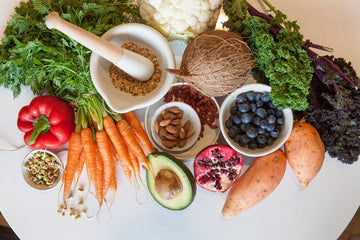
With the increasing popularity of plant-based diets, the term phytonutrient is becoming a topic of discussion. Today we delve deep into the world of phytonutrients, their benefits, and how they can transform your life. Let’s embark on this enlightening journey together!
What are Phytonutrients?
Also known as phytochemicals, are natural compounds produced by plants to protect themselves against environmental stressors, such as UV radiation, pests, and diseases. These compounds not only safeguard the plants but also offer numerous health benefits to those who consume them. Phytonutrients are responsible for the vibrant colors, aromas, and flavors of fruits, vegetables, herbs, and spices, making them an essential component of a wholesome diet.
Phytonutrients, found in whole foods, help balance the body and maintain key processes between all of our health systems.*
Pronounced fight-o-nutrient
Phyto is the Greek word for plant.
Hence, mean plant-based nutrients.
They are commonly obtained from fruits and vegetables.
They protect plants from UV radiation, pests, and diseases.
These compounds not only safeguard the plants but also offer numerous health benefits to those who consume them.
Therefore, consuming these food items will be beneficial to our bodies as well.
In line with the latest research showing a connection between longer health spans and a diet rich in phytonutrients, Foundational Nutrition expands on traditional nutrient recommendations to include these active compounds. Phytonutrients, which are also micro in size, are found in the roots, seeds, fruits, and leaves of plants, and support the body in ways that help optimize nutrition each day, and with age.*
- Stress adaptogens
- Antioxidants
- Functional mushrooms
- Superfoods
Classes of Phytonutrients:
You will be surprised to know that there are over 100,000 types of phytonutrient and they can be classed in these 3 broad categories:
- Fruits & Veggies
- Herbs & Spices
- Medicinal plants

Types of Phytonutrients
You will find a common list of phytonutrients below:
- Polyphenols
- Terpenoids
- Resveratrol
- Lutein
- Glucosinolates
- Flavonoids
- Carotenoids
- Lycopene
- Anthocyanines
- w-3 fatty acids
- Phytosterols
Resveratrol is commonly found in purple fruits and vegetables.
Allicin is commonly found in white fruits and vegetables.
Carotenoids is commonly found in orange and yellow fruits and vegetables.
Lutein is commonly found in green fruits and vegetables.
Lycopene is commonly found in red fruits and vegetables.
Of course, there are a lot of other phytonutrients as well

Health Benefits of Phytonutrients
Red fruits and vegetables such as apples, red turnips, cranberries, tomatoes contain phytonutrients that promote heart health.
The colour of the fruit and vegetable determines the type of phytonutrient that it has.
Yellow/Orange fruits and vegetables such as pineapples, corn, carrots, oranges, contain phytonutrients that promote vision health.
White fruits and vegetables such as mushrooms, garlic, onions, turnips, contain phytonutrients that promote bone and joint health.
Green fruits and vegetables such as green tea, broccoli, kale, green peas contain phytonutrients that promote cellular health.
Purple/blue fruits and vegetables such as grapes, blueberries, eggplant, sweet potato, contain phytonutrients that promote brain health.
Foods That Are High In Phytonutrients
Tomatoes, Potatoes, Citrus Fruits, Carrots
Broccoli, Bok Choy, Kale, Spinach
Brown Rice, Barley, Quinoa
Black Coffee, Green Tea, Herbal Teas
Green Beans, Peas, Soy Beans
Almonds, Walnuts, Flaxseeds
Black Chocolates
Garlic, Leek, Onions

References
Merriam-Webster: https://www.merriam-webster.com/dictionary/phyto-
Metcalf, E. https://www.webmd.com/diet/phytonutrients-faq
Levy, J. (2021, March 8) https://draxe.com/nutrition/phytonutrients/
Gupta, C., & Prakash, D. (2014, September) https://pubmed.ncbi.nlm.nih.gov/25051278/
Why phytonutrients? https://www.nutrilite.com.my/en/article/why-phytonutrients
Liu, R. H. (2003, September 1). https://academic.oup.com/ajcn/article/78/3/517S/4689990
Reading Labels: If You Really Have To Buy Something Processed https://drhyman.com/wp-content/uploads/2012/02/ReadingLabels.pdf
Phytonutrients – Nature’s Natural Defense: https://www.unlockfood.ca/en/Articles/Vitamins-and-Minerals/Phytonutrients-%E2%80%93-Nature%E2%80%99s-Natural-Defense.aspx


